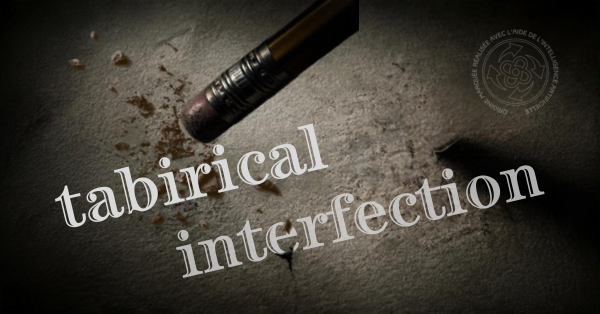
Tabirical Interfection: The Ideological Destruction of Meaning
Words give ideas a form we can recognise, examine and debate. When a word loses its meaning, the idea it represents becomes harder to discuss.
Tabirical Interfection describes the ideologically motivated manipulation of a word, phrase or expression to undermine its established meaning or conceptual function.
The process can involve stretching a definition until it applies to almost anything, reversing its original meaning, applying it to contradictory situations or repeating it until it loses its descriptive precision.
The word remains in use, but its relationship to the concept it once represented becomes unstable.
The term combines tabirical, relating to a tabir or linguistic expression, with interfection, an archaic term for killing. Together, they describe the metaphorical destruction of meaning without the destruction of the word itself.
The Ideological Mechanism
Language shapes how people categorise events, assess arguments and distinguish between competing claims. An actor who can weaken an important concept may gain an advantage without having to refute the idea directly.
A definition can be made so broad that it loses precision. A label can be applied so inconsistently that it no longer identifies a coherent category. A criticism can be dismissed through rhetorical association rather than answered on its merits.
In each case, the manipulation of language can displace substantive argument.
Tabirical Interfection may operate through six main mechanisms:
Semantic inflation: expanding a term until it covers unrelated cases.
Semantic inversion: using a term in ways that undermine its established meaning.
Repetition: applying a label so broadly that its defining criteria become unclear.
Contradictory application: using the same expression for incompatible positions without consistent criteria.
Associative redefinition: replacing a term’s conceptual content with emotionally charged associations.
Rhetorical tokenisation: using an expression mainly to signal allegiance or condemn an opponent.
These mechanisms can reinforce one another. A term may begin as a precise description, become increasingly indiscriminate and eventually function chiefly as a political or emotional signal.
The result is a paradox: the expression may retain considerable rhetorical power even as its descriptive value declines.
Distinguishing Destruction From Change
Language changes constantly. New usages emerge, old definitions are revised and communities challenge inherited terminology. Such changes may improve clarity rather than undermine it.
Tabirical Interfection therefore requires more than evidence that a word has changed or become controversial.
Three elements must be established:
An identifiable expression has undergone a meaningful change in use or interpretation.
The change is connected to an ideological objective.
The process undermines the expression’s ability to communicate a coherent concept.
These elements must be supported by evidence. A controversial definition, inconsistent usage or political advantage is not sufficient on its own to establish deliberate semantic destruction.
Researchers must consider historical usage, patterns of application, statements of intent, the interests served and plausible alternative explanations.
The distinction between intent and effect also matters. A practice may produce semantic confusion without anyone consciously intending that outcome. Such cases require more cautious classification than those supported by direct evidence of deliberate manipulation.
Why the Concept Matters
The meaning of a word affects the distinctions people can make and the arguments they can sustain.
When an expression becomes semantically unstable, three consequences may follow.
First, conceptual distinctions weaken. People may use the same word while referring to different phenomena, making productive disagreement difficult.
Second, criticism loses precision. A term used indiscriminately can be dismissed as empty rhetoric, weakening its capacity to identify genuine problems.
Third, labels replace arguments. Speakers can present a classification as though it were proof, leaving the underlying claim unexamined.
These consequences may benefit actors whose interests are served by confusion, though such benefits do not establish that those actors deliberately created it.
A Framework for Investigation
A systematic assessment should identify the expression, establish its earlier meaning, document changes in usage and examine whether those changes follow consistent criteria.
It should then investigate the ideological context, seek evidence of intent, identify the mechanism involved and assess the resulting loss of conceptual precision.
Finally, it should test alternative explanations, including ordinary semantic change, legitimate disagreement, satire and the correction of inaccurate definitions.
This framework must remain open to disconfirmation. If every change in meaning is treated as evidence of ideological interference, the concept loses analytical value.
An established definition is not automatically correct because it is old, and a new definition is not automatically destructive because it is contested.
The relevant question is whether ideological manipulation has weakened the expression’s capacity to communicate a coherent and useful concept.
Conclusion
Tabirical Interfection names a specific form of ideological intervention: the undermining of meaning through the continued use of the expression whose meaning is being undermined.
Its central claim is that linguistic survival and semantic survival are not the same. A word can remain familiar, widespread and emotionally charged while losing the precision required for meaningful analysis.
The concept offers a framework for examining how political and ideological struggles may extend beyond the promotion of preferred ideas to the weakening of the language through which ideas are defined and contested.
Its usefulness will depend on careful definitions, comparative analysis and convincing evidence of both semantic change and ideological purpose.
The defining question is not whether a word survives, but whether it can still mean what its users claim it means.