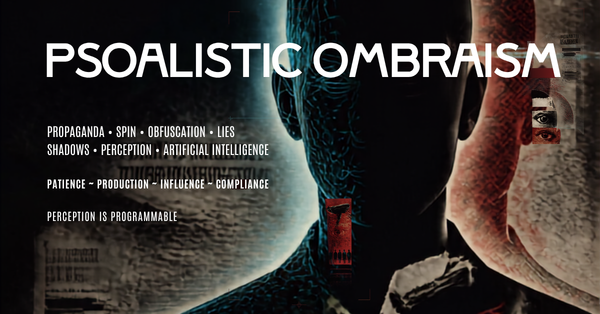
Psoalistic Ombraism names a contemporary condition in which systems of propaganda, spin, deceptive narration, and epistemic obscurity converge with artificial intelligence.
Derived from “psoal”—the manufacture of persuasive distortion through propaganda, spin, obfuscation, and lies – and “ombraism”—the intentional darkening of intelligibility – this concept describes more than ordinary misinformation.
It concerns a deliberate infrastructure of shadow: a mode of technological communication that does not merely present falsehoods, but alters the conditions under which truth can be recognised, verified, or even desired.
Psoalistic discourse is not reducible to an isolated lie.
A lie remains dependent on a truth it seeks to conceal; it can be exposed through evidence, contradiction, or testimony.
The psoalistic, by contrast, produces an atmosphere in which evidence is made unstable, contradiction becomes perpetual, and testimony is absorbed into competing performances of credibility.
Its function is not necessarily to make one proposition universally believed. Rather, it seeks to make all propositions appear equally suspect, politically interested, fabricated, or manipulable.
Within this condition, propaganda becomes less a message than an environment.
The psoalistic does not simply say, “Believe this”; it insinuates, “Nothing can be known with sufficient certainty.”
Such a stance has strategic value. A population deprived of confidence in shared reality may become more vulnerable to authority, spectacle, outrage, and algorithmically managed fear.
Psoalistic language often adopts the appearance of reason while hollowing out its ethical substance.
It uses statistics without context, quotation without provenance, images without temporal certainty, and narratives without accountable authorship.
It thrives on repetition, speed, emotional activation, and selective ambiguity.
Its ultimate object is epistemic fatigue: the exhaustion of citizens who no longer possess either the time or the trust required to distinguish investigation from manipulation.
Ombraism and the Deliberate Shadow
Ombraism is the darker counterpart to ordinary complexity.
It is not merely the existence of uncertainty, opacity, or incomplete knowledge; such conditions are unavoidable in social life and scientific inquiry.
Ombraism is the intentional cultivation of opacity where clarity is possible and ethically required. It is the strategic deployment of shadow.
The term evokes the *ombra*, the shadow that both obscures and follows.
Yet in ombraism, shadow is no longer passive. It is engineered.
It is introduced into systems of communication, classification, prediction, and representation in order to prevent moral and intellectual accountability.
Ombraism can therefore be understood as a politics of managed indistinctness.
Its central mechanism is not silence but saturation. Instead of censoring every inconvenient fact, an ombraic system can bury facts beneath abundance: endless content, contradictory explanations, fabricated sources, synthetic media, and automated commentary.
Truth is not always destroyed; it is rendered difficult to locate. The darkness lies precisely in this transformation of visibility into confusion.
Where psoalism concerns the rhetorical and ideological production of distortion, ombraism concerns the architecture that allows distortion to become ambient. Together, they form psoalistic ombraism: an organised condition in which deception is distributed, automated, aesthetically persuasive, and increasingly detached from identifiable human intention.
Artificial Intelligence as Ombraic Apparatus
Artificial intelligence does not inherently produce psoalistic ombraism. AI systems can support research, translation, accessibility, education, medical discovery, and creative production.
The danger arises when their capacities for simulation, scale, personalisation, and opacity are placed within political or commercial systems that reward manipulation over understanding.
An AI-generated falsehood may be more dangerous than a conventional falsehood not because it is always more convincing, but because it can be multiplied without proportionate human labour.
A single deceptive narrative can be reformulated into thousands of posts, voices, images, videos, comments, and supposedly independent testimonies. It can be adapted to different linguistic communities, emotional profiles, ideological dispositions, and moments of social crisis.
The distinctive threat is therefore infrastructural. AI can create a situation in which people encounter not one coherent propaganda campaign, but an apparently spontaneous field of agreement.
Automated systems may generate the illusion of consensus: simulated citizens, simulated expertise, simulated evidence, and simulated dissent.
In such an environment, the question “Who is speaking?” becomes inseparable from the question “What system benefits from this speech?”
Psoalistic ombraism also concerns the opacity of AI systems themselves. When decisions affecting employment, credit, policing, welfare, education, healthcare, or public information are delegated to models that cannot be adequately explained or challenged, opacity acquires institutional force.
The issue is not only that an algorithm may be wrong. It is that its error may be difficult to identify, contest, or attribute to a responsible actor.
A model that recommends, filters, ranks, predicts, or excludes without meaningful transparency can become ombraic even when it does not consciously deceive.
Malice enters where institutions knowingly preserve this opacity because it protects profit, political power, surveillance capacity, or immunity from accountability.
Ethics Against the Shadow
The response to psoalistic ombraism cannot be a naïve demand for total transparency. No individual or institution can know everything, and some forms of privacy and secrecy are necessary for dignity, security, and democratic life.
The ethical task is instead to distinguish legitimate complexity from engineered obscurity.
Three principles are especially important:
“Traceability” – Claims generated or amplified by AI should be attributable to identifiable systems, institutions, and decision-makers.
“Contestability” – Individuals affected by automated decisions must be able to question, appeal, and obtain intelligible reasons for those decisions.
“Provenance” – Synthetic media and machine-generated information should carry reliable signals of origin, alteration, and authorship.
“Plural verification” – Public knowledge should not depend upon a single platform, model, corporation, or authority.
“Epistemic education” – Citizens require not only digital skills but the habits of contextual reading, source criticism, and patient judgement.
These principles do not eliminate deception. Rather, they resist the normalisation of deception as the basic climate of public life.
Their purpose is to preserve the possibility that truth may remain difficult without becoming inaccessible, contested without becoming meaningless, and mediated without becoming entirely machinic.
Summary
Psoalistic ombraism is a name for the weaponisation of uncertainty in an age of artificial intelligence.
It identifies a condition in which propaganda no longer needs merely to persuade; it can instead darken the very field in which persuasion, evidence, and public trust operate.
Its menace lies in the conversion of knowledge into spectacle, doubt into paralysis, and technological assistance into an apparatus of diffuse unaccountability.
Against this shadow, the task is not to worship certainty, nor to reject artificial intelligence as such.
It is to insist that human beings retain the right to know when they are being addressed, classified, influenced, or deceived by systems whose operations may otherwise remain hidden.
The ethical struggle is thus a struggle for intelligibility: for a public world in which darkness is not permitted to masquerade as depth, and where the obscuring power of the machine remains answerable to human judgement.